Research Article | | Peer-Reviewed

Analysis of the Coupled Effects of Thermal Conductivity, Emissivity, and Rayleigh Number on the Thermal Behavior of a Porous Cavity

Received: 16 December 2025     Accepted: 30 December 2025     Published: 29 January 2026
Views:       Downloads:
Abstract

This study presents a numerical investigation of coupled heat transfer in a partitioned two-dimensional cavity containing two porous zones interacting with the main fluid region. The Darcy–Forchheimer–Brinkman model is used to describe the momentum transport and fluid–porous medium interactions by accounting for viscous diffusion, permeability resistance, and inertial effects inside the porous layers, while the thermal behavior is governed by the combined effects of conduction, natural convection, and surface radiation. The numerical results show that the introduction of porous media significantly weakens buoyancy-driven flow, leading to attenuated circulation cells, straighter and more parallel isotherms, and a clear reduction in the convective Nusselt number along the heated walls. It is also demonstrated that increasing the effective thermal conductivity of the porous medium enhances heat conduction through the solid matrix and modifies the overall flow structure by redistributing the temperature gradients between the fluid and the porous zones. The Rayleigh number is identified as the primary parameter controlling the transition between conduction-dominated and convection-dominated regimes, with low values corresponding to diffusion-controlled heat transfer and higher values promoting stronger convection even in the presence of porous obstacles. In addition, radiative heat transfer is found to be mainly governed by wall emissivity and the thermal properties of the cavity boundaries, and higher emissivity markedly increases the radiative contribution to the total Nusselt number by reinforcing surface-to-surface thermal exchanges, which partially compensates for the attenuation of convection induced by the porous layers. These findings provide valuable physical insight and practical guidelines for the thermal design and optimization of passive systems incorporating porous materials such as solar distillers, thermal insulation components, and energy storage devices operating under combined heat transfer modes.

Published in International Journal of Energy and Environmental Science (Volume 11, Issue 1)
DOI 10.11648/j.ijees.20261101.11
Page(s) 1-14
Creative Commons

This is an Open Access article, distributed under the terms of the Creative Commons Attribution 4.0 International License (http://creativecommons.org/licenses/by/4.0/), which permits unrestricted use, distribution and reproduction in any medium or format, provided the original work is properly cited.

Copyright

Copyright © The Author(s), 2026. Published by Science Publishing Group

Keywords

Partitioned Cavity, Porous Medium, Natural Convection, Radiation

1. Introduction
Numerical and experimental studies have shown that natural convection in a square cavity is influenced by radiation, especially at high Rayleigh numbers, where it modifies both temperature and flow structures. Emissivity increases the radiative share of the total heat flux, as demonstrated by Akiyama and Chong . Raji et al. showed that periodic cooling from the top enhances heat transfer by up to 46.1%. Karatas and Derbentli experimentally confirmed that the average Nusselt number increases as the aspect ratio of the cavities decreases. Faye et al. demonstrated that a porous medium reduces heat transfer in a cavity depending on its position, while physical parameters influence the Nusselt numbers.
Mobedi concluded that heat transfer increases with Ra and thermal conductivity, then stabilizes beyond a ratio of 10. Elaprolu et al. showed that in a porous cavity subjected to mixed convection, the average Nusselt number decreases when the Richardson number increases. Grosan et al. demonstrated that applying a magnetic field reduces heat transfer in a porous cavity, with a horizontal field being more effective than a vertical one. Faye et al. showed that in a porous medium, heat transfer increases with thermal conductivity up to a maximum, decreases with increasing porosity, and rises when the medium's permeability increases.
P. A. Tyvand studied how hydrodynamic dispersion affects the onset of thermal convection in an anisotropic porous medium. He showed that longitudinal dispersion has no effect on the instability threshold, while lateral dispersion stabilizes the flow. Perturbations form stationary rolls aligned with the direction of the main flow.
Massoud demonstrated that heat transfer of CO in porous tubes strongly depends on pressure, flow rate, heat flux, and porosity. Near the supercritical state, finer particles improve heat transfer by 20–30%. Heat transfer increases with higher mass flow rate and lower pressure. The results agree with experimental data.
J. Ni and C. Beckermann conducted a numerical study analyzing natural convection in a vertical annulus filled with an anisotropic porous medium. Hydrodynamic anisotropy strongly influences flow, temperature, and heat transfer, more than thermal anisotropy. Convection and the Nusselt number increase with vertical permeability, Rayleigh number, and radius ratio, but decrease with aspect ratio and permeability ratio. A correlation for heat transfer as a function of the main parameters is proposed.
This numerical study aims to evaluate the influence of two porous-filled alveoli on heat transfer. Due to anisotropic conditions and random grain distribution, the Darcy–Forchheimer–Brinkman model was used, linking pressure drop to velocity, permeability, viscosity, and porosity, as proposed by Epherre and Tyvand . First, the effect of the two alveoli on heat transfer is analyzed. Then, the heat transfer rate is studied as a function of the cavity’s thermal conductivity through the Nusselt number. Finally, the impact of emissivity and Rayleigh number variations on the local Nusselt number is examined.
This article presents a numerical model designed to study heat transfer by natural convection in a porous medium saturated with a nanofluid. Although thermal radiation is not the main focus of the study, the results highlight the decisive role of interactions between convection and overall heat transfer within complex porous structures, as demonstrated by Kramer and al. .
This study investigates the combined effects of thermal radiation and natural convection of a hybrid nanofluid (Al₂O₃–Cu–water) within a π-shaped cavity saturated by a porous medium under the influence of a magnetic field. The findings reveal that thermal radiation significantly alters the flow patterns, temperature distributions, and the overall heat transfer characteristics of the system. Study by Rashad and al. .
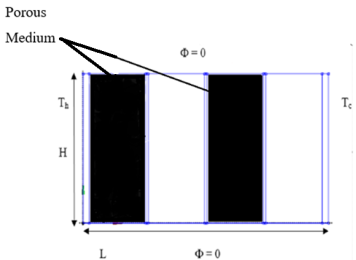
Figure 1. System geometry. System geometry.
2. System Description
The system under study is a partitioned 2D cavity with dimensions of 317 × 200 mm, bounded by two vertical walls and three internal partitions. The vertical walls are subjected to uniform temperatures (Th and Tc), while the horizontal surfaces are adiabatic. The enclosure is primarily filled with air, but two alveoli contain a porous medium. The external walls have a thickness of 8 mm, whereas the internal partitions have a thickness of e = 3 mm.
Simplifying Assumptions and Mathematical Formulation
The study considers a Newtonian fluid flowing in a steady, laminar, and two-dimensional manner through a homogeneous and isotropic porous matrix. Thermophysical properties are assumed constant, while Soret and Dufour effects are neglected, and the Boussinesq approximation is used. The extended Darcy model, including the Brinkman and Forchheimer terms, is applied.
The Boussinesq approximation: = o[1-βTT-To ].
The equations of heat transfer, motion and continuity in a porous medium can then be written as follows.
The equations of heat transfer, motion and continuity in a porous medium can then be written in the following forms.
Forming the equations dimensionally
Normalization consists in transforming the dependent and independent variables into dimensionless variables.
We obtain the following equations
1) the porous region
Continuity
(U)x + Vz = 0(1)
Move
1 [1 (UUX+UVZ)] = - PX + 1 PrRa1/2( 2UX2  +2UZ2 )- 1Da PrRa1/2U - CfDa1/2U2+V2 U (2)
1 [1 (VUX+VVZ)] = - PZ + 1 PrRa1/2( 2VX2  +2VZ2 ) - 1Da PrRa1/2V - CfDa1/2U2+V2 V+ θ(3)
Heat transfer
(Uθx+VθZ)= eff PrRa-1/2(2θx2 +2θZ2 ) (4)
2) the fluid region:
Continuity
(U)x + Vz = 0(5)
Move
(UUX+UVZ) = - PX + PrRa1/2(2UX2  +2UZ2  ) (6)
(VUX+VVZ) = - PZ + PrRa1/2(2VX2  +2VZ2  ) + θ(7)
Heat transfer
(Uθx+VθZ)= PrRa-1/2(2θx2 +2θZ2  ) (8)
Boundary conditions
(X=0; Z) =0,(X=L; Z) = 1 (9)
3) Radiative transfer
(I<sup></sup>(r,s),s) = 0(10)
I<sup></sup>(r,s): is the radiant intensity. It is given by the following relation
I<sup></sup>(r,s) = I(r,s) /(T04)(11)
The dimensionless equation for the radiative flux intensity at the boundary (X=X0) is given by the following relationship:
I<sup></sup>(X0,Z) =*rad(X0,Z)/(12)
In the cells and in the walls, the equation is:
(2θx2 +2θZ2  ) = 0 (13)
At the vertical solid-fluid interface located at X = X0, temperatures verify
s(X0; Z) =f(X0; Z)(14)
The energy balance at point X = X0 (solid-fluid interface) can be deduced from this:
θsXX=X0= Nr*rad(X0, Z) +1r θfXX=X0(15)
The radiant and conductive interaction parameter Nr is given by the following relationship:
Nr=T04 H /s(Tch– Tfr)(16)
The radiative flux density passing through the surface at points (X = X0, Z) is given by the following relationship:
*rad(X0, Z) = (1-)*rad,in(X0, Z) +T4/T04(17)
*rad,in is called the flux density of incident radiation heat on the surface.
It is calculated by the following relationship:
*rad,in= Iin. s  n d(18)
Heat transfer
We give the convective and radiative heat transfer rates on walls and partitions by the radiative and convective Nusselt numbers are defined by:
Nucv(X0) = 01θfXx=x0 θf,cdXX=X0  dz (19)
Nurad(X0) = Nrr 01rad(X0,Z) θf,cdXX=X0  dz(20)
θf,cd fliude temperature in the case of conduction only.
3. Results and Discussion
The study numerically analyzes a PVC cavity containing a porous medium of terracotta beads (φ = 0.55) to examine how the porous structure and physical parameters affect heat transfer, with results presented as streamlines, isotherms, and Nusselt numbers.
3.1. Effect of Incorporating Two Porous Media Within a Partitioned Cavity
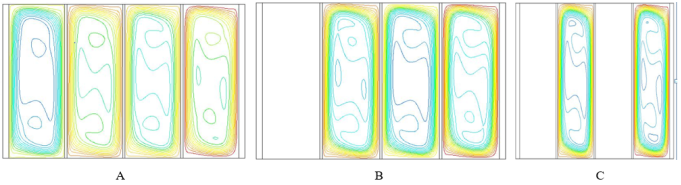
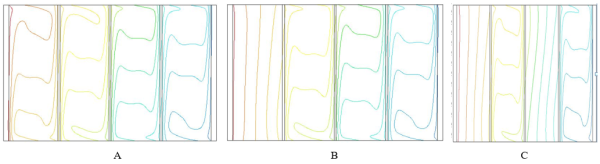
Figures 2 and 3 illustrate the effect of the porous medium on the flow and heat transfer within the cavity. In Case A (without a porous medium), the streamlines show well-developed recirculation cells, indicating strong natural convection. The isotherms are highly curved, confirming that heat transfer is dominated by advection.
In Case B, the introduction of a porous medium visibly weakens the flow: the cells become weaker and the streamlines less dense. The isotherms become more vertical and smoother, indicating a reduction in convection and an increase in conduction.
Finally, in Case C, the presence of two porous regions further reduces circulation: the vortices are greatly weakened and confined to the non-porous zones. The isotherms appear almost straight, indicating a predominantly conductive thermal regime.
Thus, the more porous the cavity becomes, the more convection decreases in favor of conduction.
Figure 2. Streamlines. Streamlines.
Figure 3. Isotherms. Isotherms.
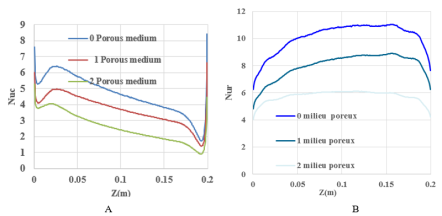
Figure 4. Variation of local convective (A) and radiative (B) Nusselt numbers along the height Z for different cases: no porous medium, single porous medium, and two porous media. Variation of local convective (A) and radiative (B) Nusselt numbers along the height Z for different cases: no porous medium, single porous medium, and two porous media.
The curves are plotted for the vertical position Z ranging from 0 to 0.2.
For the convective Nusselt number (Figure 4A), the value drops rapidly near Z = 0, then tends to stabilize or decrease more gradually. The presence of one or more porous media leads to a notable reduction in the convective Nusselt number compared to the case without porosity, particularly in the lower part of the cavity.
Regarding the radiative Nusselt number (Figure 4B), its values are generally higher than those of the convective Nusselt number (maximum scale around 12 versus 9). It also decreases with Z, but follows a more regular trend, nearly linear or slightly curved. The differences between the three configurations are less pronounced than for convective heat transfer.
It can be deduced that the presence of a porous medium slows down the fluid flow, which reduces the intensity of convective exchanges and explains the decrease in the convective Nusselt number. The more porous regions there are, the more convection is inhibited, and the less convective heat transfer contributes to the overall heat transport.
From the perspective of radiative heat transfer, however, the radiative Nusselt number is relatively little affected by porosity, as radiation mainly depends on temperature, the optical properties of the materials, and the geometry, rather than the fluid dynamics. The small differences observed between configurations arise from changes in the temperature fields due to variations in conduction and convection.
Overall, the introduction of porous media strongly attenuates convection, which enhances the radiative contribution to heat transfer, particularly in the lower part of the domain. Increasing the number of porous regions further emphasizes this radiative dominance and further reduces the effect of convective mechanisms.
3.2. Influence of Cell Face Thermal Emissivity
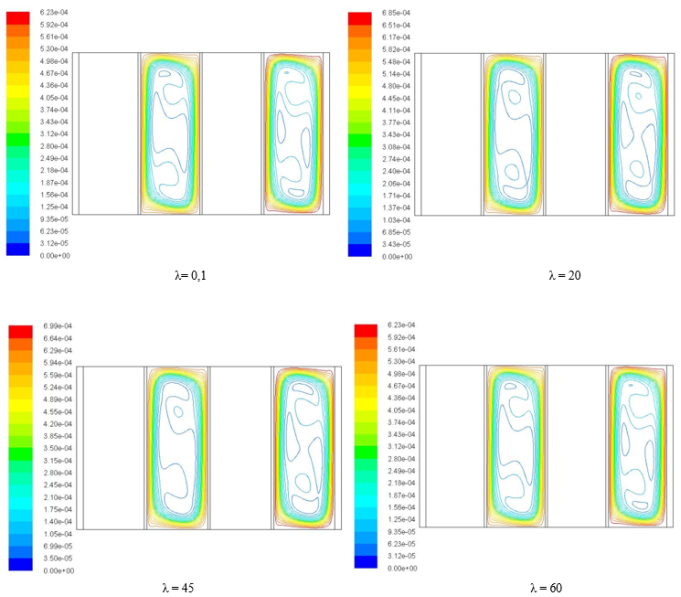
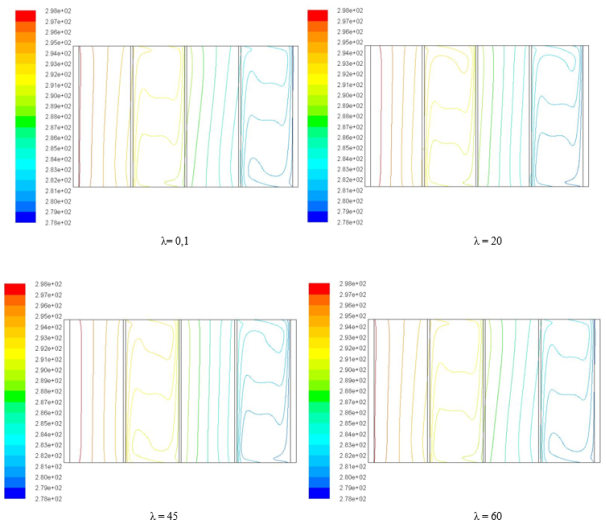
Figures 5 and 6 show, respectively, the evolution of streamlines and isotherms for different values of the relative thermal conductivity λ. The analysis clearly indicates that the fluid and heat transport mechanisms are strongly conditioned by the value of λ, revealing a gradual transition from a convection-dominated regime to a primarily conductive regime.
For λ = 0.1, the streamlines highlight well-developed and dynamic recirculation cells, indicating intense natural convection. This fluid dynamics is reflected in the configuration of the isotherms, which are highly curved, signaling high thermal gradients and heat transfer largely controlled by advection.
When the conductivity increases to λ = 20, a significant decrease in convective intensity is observed. The recirculation cells become more moderate and their structure stabilizes. Simultaneously, the isotherms gradually straighten, indicating a reduction in thermal distortion induced by fluid motion and an enhanced role of conduction.
For λ = 45, the flow shows a marked weakening: the streamlines are less dense, and the vortices are significantly less vigorous. The isotherms take an almost vertical configuration over most of the domain, reflecting heat transfer dominated by conduction.
Finally, at λ = 60, natural convection is strongly suppressed. The residual recirculation cells are weakly formed and confined to limited regions. The isotherms appear almost straight and parallel, confirming that heat transfer is now controlled almost exclusively by conduction, with the convective effect becoming marginal.
Overall, increasing λ produces a stabilizing effect on the temperature field and a gradual damping of convective structures. This behavior reflects a decrease in the driving force associated with thermal gradients and highlights the system’s sensitivity to relative thermal conductivity.
Figure 5. Streamlines. Streamlines.
Figure 6. Isotherms. Isotherms.
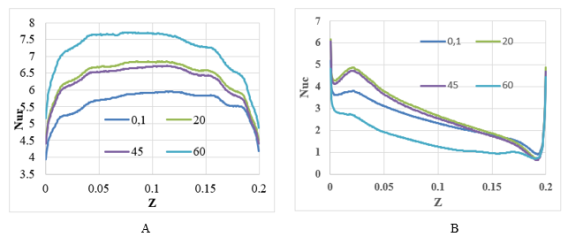
Figure 7. Variation of local convective (A) and radiative (B) Nusselt numbers along the height Z for different thermal conductivity cases: λ = 0.1, λ = 20, λ = 45, and λ = 60. Variation of local convective (A) and radiative (B) Nusselt numbers along the height Z for different thermal conductivity cases: λ = 0.1, λ = 20, λ = 45, and λ = 60.
Figures 7A and 7B show the variation of the convective and radiative Nusselt numbers along the height Z for different thermal conductivities of the porous medium. The convective Nusselt number (Figure 7B) exhibits a sharp increase near the base, followed by a nearly stationary region between Z = 0.05 and 0.15, and then a decrease towards the top. The influence of conductivity is clear: low conductivity (λ = 0.1) strongly reduces Nuc due to high thermal resistance and flow inhibition, whereas higher conductivities (λ = 20, 45, 60) promote more significant convective heat transfer.
In contrast, the radiative Nusselt number (Figure 7A) varies less significantly with conductivity. It shows a monotonic decrease from the base to the top, with relatively small differences between the various λ values. Radiation mainly depends on temperature levels and the radiative properties of the walls, explaining its low sensitivity to the porous medium.
Overall, the thermal conductivity of the porous material strongly influences convective mechanisms but only marginally affects radiation. For high conductivities, convection becomes more effective, while radiation remains a stable and dominant heat transfer mode in the lower part of the cavity.
3.3. Influence of Rayleigh Number on Heat Transfer
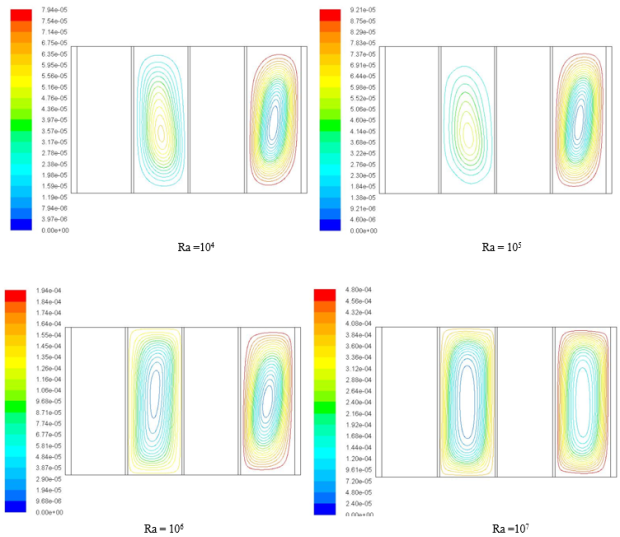
For Figure 8, which shows the streamlines, it can be observed that for Ra = 104, the flow remains weakly structured, characterized by broad and weak convection cells. This behavior reflects a conduction-dominated regime, where the buoyancy force is insufficient to induce significant fluid motion.
At Ra = 105, natural convection gradually intensifies: the cells become more compact and better defined, indicating a notable increase in induced velocities. The flow reorganizes into more symmetric and energetic structures.
When Ra = 106, the streamlines tighten and elongate vertically, indicating clearly dominant convection. Rising hot plumes and descending cold plumes stabilize along the walls, increasing the intensity of convective heat transport.
Finally, for Ra = 107, the flow reaches a strongly convective regime, close to a pre-turbulent state. The cells become finer and more dynamic, reflecting a strong amplification of buoyancy forces and very vigorous internal circulation.
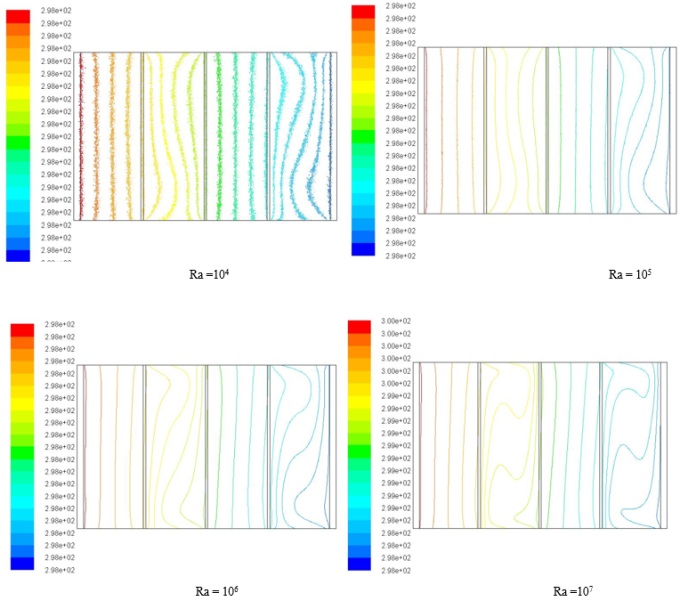
Similarly, for Figure 8, which shows the isotherms, the isotherms associated with Ra = 104 are nearly vertical, characteristic of predominantly conductive heat transfer. The absence of significant deformation confirms the weakness of fluid motion in this regime.
At Ra = 105, the isotherms begin to curve due to the gradually established convection. Thermal gradients increase near the walls, highlighting the emergence of ascending and descending flows.
For Ra = 106, the deformation of the isotherms becomes pronounced, revealing intense convective transport and faster redistribution of heat within the cavity. The hot and cold regions extend vertically, consistent with the intensification of buoyancy.
At Ra = 107, the isotherms are strongly curved and tightly packed, indicating highly efficient thermal mixing. Heat transfer is dominated by convection, while conduction becomes secondary. This regime is characterized by localized thermal gradients and a nearly unsteady fluid behavior.
Figure 8. Streamlines. Streamlines.
Figure 9. Isotherms. Isotherms.
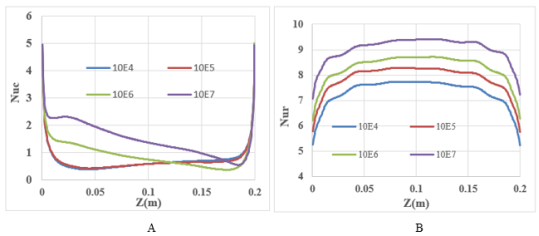
Figure 10. Variation of the local convective (A) and radiative (B) Nusselt numbers as a function of the height Z for the different Rayleigh number cases: Ra = 104, 105, 106, and 107. Variation of the local convective (A) and radiative (B) Nusselt numbers as a function of the height Z for the different Rayleigh number cases: Ra = 104, 105, 106, and 107.
The variation of the local Nusselt number along the vertical coordinate Z is presented for different Rayleigh numbers ranging from 104 to 107. It is observed that the local Nusselt number is high near the lower and upper walls of the cavity, then decreases toward the central region. This behavior reflects a more intense heat transfer at the extremities, due to strong thermal gradients and fluid recirculation, while the middle part exhibits weaker exchanges because of a more uniform temperature field.
For low Rayleigh numbers (Ra = 104 and Ra = 105), the Nusselt number remains low and nearly constant along the height, indicating that heat transfer is mainly conduction-dominated. When the Rayleigh number increases (Ra = 106), a moderate convective motion develops, slightly enhancing the local heat transfer near the cavity walls. For higher values (Ra = 107), convection becomes dominant, resulting in a significant increase in the local Nusselt number, particularly in the upper and lower regions.
Overall, the results show that an increase in the Rayleigh number intensifies convective effects, shifting the heat transfer mechanism from a purely conductive regime to one dominated by convection, characterized by marked local variations of the Nusselt number along the vertical axis.
The presented figure illustrates the variation of the local radiative Nusselt number (Nur) as a function of height Z for different Rayleigh numbers (Ra = 104, 105, 106, and 107). It is observed that, for all studied cases, the distribution of Nur exhibits a quasi-parabolic shape: it increases rapidly near the bottom, reaches a maximum at the center of the cavity (around Z = 0.1 m), and then gradually decreases toward the upper part.
The increase in the Rayleigh number leads to an overall rise in Nur values, reflecting an enhancement of heat transfer by natural convection. Indeed, a higher Ra corresponds to stronger fluid motion, which promotes thermal exchanges and increases the contribution of radiation to the overall heat transfer.
Spatially, the low values of Nur observed near the lower and upper extremities (close to Z = 0 m and Z = 0.2 m) are explained by the reduced local temperature gradient and weaker fluid circulation in these regions. Conversely, the maximum located at the center of the cavity corresponds to a region of pronounced thermal interaction between the ascending hot fluid and the descending cold fluid, which intensifies the local radiative flux.
The symmetry of the obtained profiles reflects a stable thermal field and a relatively uniform distribution of the radiative flux along the height of the cavity.
Thus, it appears that increasing the Rayleigh number significantly enhances radiative transfer, particularly for Ra ≥ 106. This behavior highlights the coupling between natural convection and thermal radiation, which becomes increasingly significant in regimes of intense convection.
3.4. Effect of Wall Thermal Emissivity
Figure 11. Streamlines. Streamlines.
Figure 12. Isotherms. Isotherms.
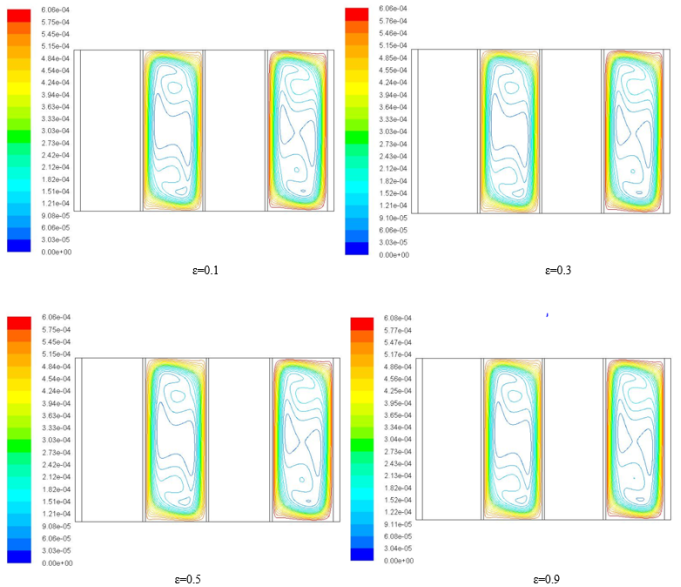
Figure 11 illustrates the evolution of streamlines inside the cavity for different emissivity values (ε = 0.1, 0.3, 0.5, and 0.9). The results clearly highlight the significant influence of thermal radiation on the structure of the convective flow.
At low emissivity (ε = 0.1), radiative heat exchanges between the walls remain limited. The flow is therefore mainly governed by conduction and natural convection mechanisms. The streamlines reveal the presence of well-defined but weak convection cells, indicating moderate fluid circulation and the dominance of diffusive effects.
As the emissivity increases to intermediate values (ε = 0.3 and ε = 0.5), the contribution of thermal radiation becomes more pronounced. This increase enhances temperature gradients near the walls, thereby intensifying buoyancy forces. Consequently, the convection cells become more developed, and the streamlines appear denser and better structured, reflecting an increase in flow intensity.
For high emissivity (ε = 0.9), radiative heat transfer dominates the overall thermal exchanges. The thermal energy transferred by radiation significantly amplifies buoyancy forces, leading to stronger and more extended convection cells. The streamlines are highly concentrated, indicating a marked intensification of natural convection and a strong coupling between convection and radiation.
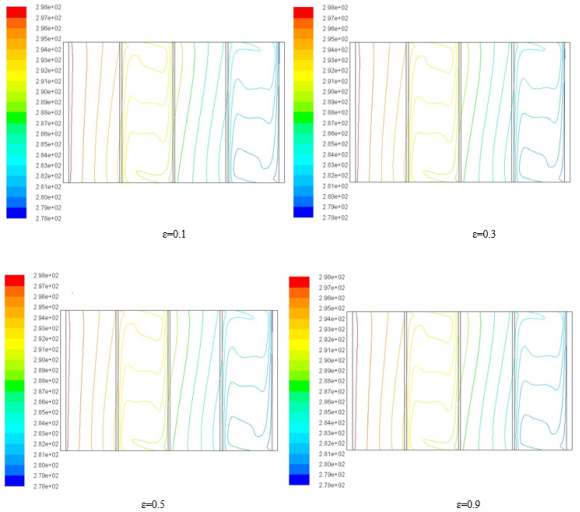
Figure 12 presents the corresponding isotherm distributions for the same emissivity values. These results allow an assessment of the evolution of the thermal field and the effectiveness of heat transfer within the cavity.
At low emissivity (ε = 0.1), the isotherms are nearly parallel and weakly distorted, which characterizes a conduction-dominated regime. High temperature gradients are observed near the active walls, while the core of the cavity exhibits pronounced thermal stratification.
For intermediate emissivity values (ε = 0.3 and ε = 0.5), the isotherms gradually become more curved, reflecting the increasing influence of natural convection enhanced by thermal radiation. The temperature distribution becomes more uniform, indicating improved thermal mixing inside the cavity.
At high emissivity (ε = 0.9), the isotherms are strongly distorted and less concentrated near the walls. This behavior reveals an enhanced homogenization of the thermal field and a reduction in local temperature gradients. Thermal radiation effectively contributes to energy redistribution, thereby improving the overall heat transfer.
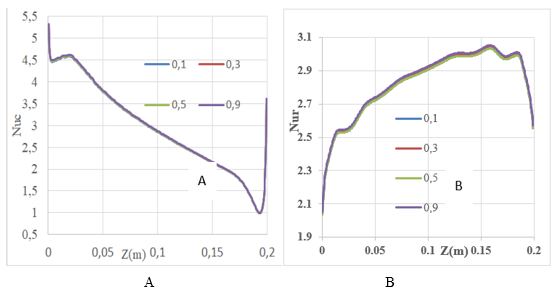
Figure 13. Variation of the local convective (A) and radiative (B) Nusselt numbers as a function of the height Z (m) for the different emissivity cases: ε = 0.1, 0.3, 0.5, and 0.9. Variation of the local convective (A) and radiative (B) Nusselt numbers as a function of the height Z (m) for the different emissivity cases: ε = 0.1, 0.3, 0.5, and 0.9.
Figure 13 illustrates the variation of the local convective (Nuc) and radiative (Nur) Nusselt numbers along the height Z of the cavity for different emissivity levels (ε = 0.1, 0.3, 0.5, 0.9). The results reveal distinct behaviors between the two modes of heat transfer.
In the case of convective transfer (Figure 13A), the local Nusselt number shows an initially high value, exceeding 5, reflecting the formation of a very thin thermal boundary layer near the hot wall. This value gradually decreases over most of the domain height due to the continuous thickening of the boundary layer and the reduction of the temperature gradient. A minimum is reached near the upper region of the cavity, followed by a noticeable rise close to the cold wall, as a direct consequence of the local enhancement of the thermal gradient. Moreover, the effect of emissivity on the convective Nusselt behavior remains marginal, with the different curves almost perfectly overlapping.
In contrast, radiative transfer (Figure 13B) shows a more pronounced sensitivity to the emissivity parameter. Nur values vary within a narrow range but slightly increase with ε, confirming that more emissive walls promote higher radiative exchange. The variation of Nur along the height indicates a gradual rise to a maximum located around Z ≈ 0.12–0.15 m, where local temperatures are highest. A slight decrease is then observed toward the upper part of the cavity.
From a physical standpoint, these results highlight the predominance of natural convection in regions close to the hot wall, while radiation becomes relatively more influential in zones with less pronounced thermal gradients. Emissivity primarily modulates the radiative component of the flux, while its impact on convection remains negligible. This separation of heat transfer mechanisms underlines the need for a coupled convection–radiation modeling approach to accurately describe the thermo-hydrodynamic behavior of the porous cavity.
4. General Conclusion
This numerical study has allowed for the analysis of heat transfer and flow mechanisms in a 2D partitioned cavity containing porous media, combining conduction, natural convection, and radiation. The use of the Darcy–Forchheimer–Brinkman model enabled precise modeling of the fluid–porous medium interaction, while the integration of radiative transfer provided a comprehensive understanding of the thermal phenomena.
The results show that the introduction of one or more porous media reduces the intensity of convective recirculations, straightens the isotherms, and decreases the convective Nusselt number, reflecting a shift toward a conduction-dominated regime. The radiative Nusselt number remains relatively independent of porosity and depends mainly on the thermal and radiative properties of the walls.
An increase in the thermal conductivity of the medium promotes conduction and reduces the insulating effect, whereas convection is strongly inhibited for very low conductivities. The study of the Rayleigh number shows the transition from a quasi-conductive regime at low Ra to fully developed convection at high Ra, with increasing convective and radiative Nusselt numbers.
Wall emissivity has little influence on convection but enhances radiative transfer, linearly increasing the radiative Nusselt number. Thus, the balance between conduction, convection, and radiation is strongly modulated by porosity, conductivity, emissivity, and the Rayleigh number.
These results provide a solid basis for the thermal optimization of cavities filled with porous media. In the long term, this work paves the way for the development of more efficient passive energy systems, such as solar heating, natural ventilation, or industrial drying, and can be extended to anisotropic media, phase-change materials, or turbulent regimes at very high Rayleigh numbers.
Abbreviations

Nuc

Nusselt convective

Nur

Nusselt radiative

Conflicts of Interest
The authors declare no conflicts of interest.
Appendix
Nomenclature

Cf

Forchheimer Coefficient

Cp

Specific Heat at Constant Pressure (J Kg-1 K-1)

Da

Darcy Number

g

Acceleration Due to Gravity (ms-2)

H

Channel Author

I

Radiation Intensity (Wm-2)

K

Permeability

L

Width (m)

Nu

Nusselt Number

P

Pressure (Pa)

Pr

Prandtl Number

Ra

Rayleigh Number

S

Solid

T

Temperature (K)

U, V

Dimensionless Velocity Components

x, z

Cartesian Coordinates (m)

X, Z

Dimensionless Cartesian Coordinate

Greek Letter

θ

Dimensionless Temperature

λ

Thermal Diffusivity (m2s-1)

ΔT

Ecart de Temperature

βT

Thermal Expansion Coefficient (K-1)

λ

Thermal Conductivity (Wm-1K-1)

λr

Thermal Conductivity Relative λ/ λair

Φ

Heat Flux Density (W/m2)

ԑ

Emissivity

Density (kgm-3)

φ

Porosity

Stefan–Boltzmann Constant

Index

c

cold

cd

conduction

cv

convection

eff

effective

f

fluid

h

hot

m

average

rd

Radiation (or rad, r)

References
[1] M. Akiyama, Q. P. Chong, Numerical analysis of natural convection with surface radiation in a square enclosure, Numer. Heat Transfer, Part A 31 (1997) 419–433.
[2] Raji, A., Hasnaoui, M., Firdaouss, M. and Ouardi, C. (2013) “Natural convection heat transfer enhancement in a square cavity periodically cooled from above”, Numerical Heat Transfer, PartA, Vol. 63, pp. 511–533.
[3] Karatas, H. and Derbentli, T. (2018) “Natural convection and radiation in rectangular cavities with one active vertical wall”, International Journal of Thermal Sciences, Vol. 123, pp. 129-139.
[4] Souleye Faye, Sory Diarra, Sidy Mactar Sokhna, Vincent Sambou “Numerical Study of Heat Transfer in a Partitioned CavityContaining a Porous Medium” Applied Engineering 2024; Vol. 8, No. 1, pp. 31-40.
[5] M. Mobedi, Conjugate natural convection in a square cavity with finite thickness horizontal walls, Int. Communication in Heat and Mass Transfer, vol. 35, pp. 503-513, 2008.
[6] V. Elaprolu, M. Das, Laminar mixed convection in a parallel two-sided lid-driven differentially heated square cavity fluid with a fluid-saturated porous medium, Numerical Heat Transfer, Part A: Applications, vol. 53: 1, pp. 88-110, 2008.
[7] T. Grosan, C. Revnic, I. Pop et D. Ingham, Magnetic field and internal heat generation effects on the free convection in a rectangular cavity filled with a porous medium, Int. Journal of Heat and Mass Transfer, vol. 52, pp. 1525-1533, 2009.
[8] Souleye Faye, Sidy Mactar Sokhna, Sory Diarra, Vincent Sambou “Effect of physical parameters of the porous medium on natural convection in apartitioned cavity”. International Journal of Innovation and Applied Studies. Vol. 42 No. 2 Apr. 2024, pp. 371-381.
[9] J. F. Epherre, ‘Criteria for the Application of Natural Convection in an Anisotropic Porous Layer,’ General Review of Thermodynamics, Vol. 168, pp. 949–950, 1975. isotropic Porous Media," AIChE Journal, Vol. 23, No. 1, pp. 56–62, 1977.
[10] P. A. Tyvand, «Heat Dispersion Effect on Thermal Convection in Anisotropic Porous Media», Journal of Hydrology, Vol. 34, N. 3-4, pp. 335 - 342, 1977.
[11] Masoud Haghshenas Fard, CFD modeling of heat transfer of CO2 at supercritical pressures flowing vertically in porous tubes. International Communications in Heat and Mass Transfer 37 (2010) 98-102.
[12] J. Ni and C. Beckermann, "Natural Convection in a Vertical Enclosure Filled With Anisotropic Porous Media", Journal of Heat Transfer, Vol. 113, N. 4, pp. 1033 - 1037, 1991.
[13] Janja Kramer Stajnko, Jure Ravnik, Renata Jecl & Matjaž Nekrep Perc. Computational Modeling of Natural Convection in Nanofluid-Saturated Porous Media: An Investigation into Heat Transfer Phenomena. Mathematics, (2024). 12(23): 3653.
[14] Rashad A. M., Kolsi L., Mansour M. A., Salah T., Mir A., Armaghani T. & Alshammari B. M. (2024). Effect of thermal radiation on unsteady magneto-hybrid nanofluid flow in a π-shaped wavy cavity saturated porous medium. Frontiers in Chemistry, 12: 1441077.
Cite This Article
  • APA Style

    Faye, S., Sarr, F., Sarr, L. A., Thiam, O. N., Sambou, V. (2026). Analysis of the Coupled Effects of Thermal Conductivity, Emissivity, and Rayleigh Number on the Thermal Behavior of a Porous Cavity. International Journal of Energy and Environmental Science, 11(1), 1-14. https://doi.org/10.11648/j.ijees.20261101.11

    Copy | Download

    ACS Style

    Faye, S.; Sarr, F.; Sarr, L. A.; Thiam, O. N.; Sambou, V. Analysis of the Coupled Effects of Thermal Conductivity, Emissivity, and Rayleigh Number on the Thermal Behavior of a Porous Cavity. Int. J. Energy Environ. Sci. 2026, 11(1), 1-14. doi: 10.11648/j.ijees.20261101.11

    Copy | Download

    AMA Style

    Faye S, Sarr F, Sarr LA, Thiam ON, Sambou V. Analysis of the Coupled Effects of Thermal Conductivity, Emissivity, and Rayleigh Number on the Thermal Behavior of a Porous Cavity. Int J Energy Environ Sci. 2026;11(1):1-14. doi: 10.11648/j.ijees.20261101.11

    Copy | Download

  • @article{10.11648/j.ijees.20261101.11,
      author = {Souleye Faye and Fallou Sarr and Lamine Arfang Sarr and Omar Ngor Thiam and Vincent Sambou},
      title = {Analysis of the Coupled Effects of Thermal Conductivity, Emissivity, and Rayleigh Number on the Thermal Behavior of a Porous Cavity},
      journal = {International Journal of Energy and Environmental Science},
      volume = {11},
      number = {1},
      pages = {1-14},
      doi = {10.11648/j.ijees.20261101.11},
      url = {https://doi.org/10.11648/j.ijees.20261101.11},
      eprint = {https://article.sciencepublishinggroup.com/pdf/10.11648.j.ijees.20261101.11},
      abstract = {This study presents a numerical investigation of coupled heat transfer in a partitioned two-dimensional cavity containing two porous zones interacting with the main fluid region. The Darcy–Forchheimer–Brinkman model is used to describe the momentum transport and fluid–porous medium interactions by accounting for viscous diffusion, permeability resistance, and inertial effects inside the porous layers, while the thermal behavior is governed by the combined effects of conduction, natural convection, and surface radiation. The numerical results show that the introduction of porous media significantly weakens buoyancy-driven flow, leading to attenuated circulation cells, straighter and more parallel isotherms, and a clear reduction in the convective Nusselt number along the heated walls. It is also demonstrated that increasing the effective thermal conductivity of the porous medium enhances heat conduction through the solid matrix and modifies the overall flow structure by redistributing the temperature gradients between the fluid and the porous zones. The Rayleigh number is identified as the primary parameter controlling the transition between conduction-dominated and convection-dominated regimes, with low values corresponding to diffusion-controlled heat transfer and higher values promoting stronger convection even in the presence of porous obstacles. In addition, radiative heat transfer is found to be mainly governed by wall emissivity and the thermal properties of the cavity boundaries, and higher emissivity markedly increases the radiative contribution to the total Nusselt number by reinforcing surface-to-surface thermal exchanges, which partially compensates for the attenuation of convection induced by the porous layers. These findings provide valuable physical insight and practical guidelines for the thermal design and optimization of passive systems incorporating porous materials such as solar distillers, thermal insulation components, and energy storage devices operating under combined heat transfer modes.},
     year = {2026}
    }
    

    Copy | Download

  • TY  - JOUR
    T1  - Analysis of the Coupled Effects of Thermal Conductivity, Emissivity, and Rayleigh Number on the Thermal Behavior of a Porous Cavity
    AU  - Souleye Faye
    AU  - Fallou Sarr
    AU  - Lamine Arfang Sarr
    AU  - Omar Ngor Thiam
    AU  - Vincent Sambou
    Y1  - 2026/01/29
    PY  - 2026
    N1  - https://doi.org/10.11648/j.ijees.20261101.11
    DO  - 10.11648/j.ijees.20261101.11
    T2  - International Journal of Energy and Environmental Science
    JF  - International Journal of Energy and Environmental Science
    JO  - International Journal of Energy and Environmental Science
    SP  - 1
    EP  - 14
    PB  - Science Publishing Group
    SN  - 2578-9546
    UR  - https://doi.org/10.11648/j.ijees.20261101.11
    AB  - This study presents a numerical investigation of coupled heat transfer in a partitioned two-dimensional cavity containing two porous zones interacting with the main fluid region. The Darcy–Forchheimer–Brinkman model is used to describe the momentum transport and fluid–porous medium interactions by accounting for viscous diffusion, permeability resistance, and inertial effects inside the porous layers, while the thermal behavior is governed by the combined effects of conduction, natural convection, and surface radiation. The numerical results show that the introduction of porous media significantly weakens buoyancy-driven flow, leading to attenuated circulation cells, straighter and more parallel isotherms, and a clear reduction in the convective Nusselt number along the heated walls. It is also demonstrated that increasing the effective thermal conductivity of the porous medium enhances heat conduction through the solid matrix and modifies the overall flow structure by redistributing the temperature gradients between the fluid and the porous zones. The Rayleigh number is identified as the primary parameter controlling the transition between conduction-dominated and convection-dominated regimes, with low values corresponding to diffusion-controlled heat transfer and higher values promoting stronger convection even in the presence of porous obstacles. In addition, radiative heat transfer is found to be mainly governed by wall emissivity and the thermal properties of the cavity boundaries, and higher emissivity markedly increases the radiative contribution to the total Nusselt number by reinforcing surface-to-surface thermal exchanges, which partially compensates for the attenuation of convection induced by the porous layers. These findings provide valuable physical insight and practical guidelines for the thermal design and optimization of passive systems incorporating porous materials such as solar distillers, thermal insulation components, and energy storage devices operating under combined heat transfer modes.
    VL  - 11
    IS  - 1
    ER  - 

    Copy | Download

Author Information
  • Polytechnic School of Dakar, Cheikh Anta DIOP University, Dakar, Senegal
  • Department of Physics, Faculty of Science and Technology, Cheikh Anta DIOP University, Dakar, Senegal

  • Polytechnic School of Dakar, Cheikh Anta DIOP University, Dakar, Senegal

  • Department of Physics, Faculty of Science and Technology, Cheikh Anta DIOP University, Dakar, Senegal

  • Polytechnic School of Dakar, Cheikh Anta DIOP University, Dakar, Senegal

  • Abstract
  • Keywords
  • Document Sections

    1. 1. Introduction
    2. 2. System Description
    3. 3. Results and Discussion
    4. 4. General Conclusion
    Show Full Outline
  • Abbreviations
  • Conflicts of Interest
  • Appendix
  • References
  • Cite This Article
  • Author Information